The Hidden Cost of a Sauna Without Proper Insulation
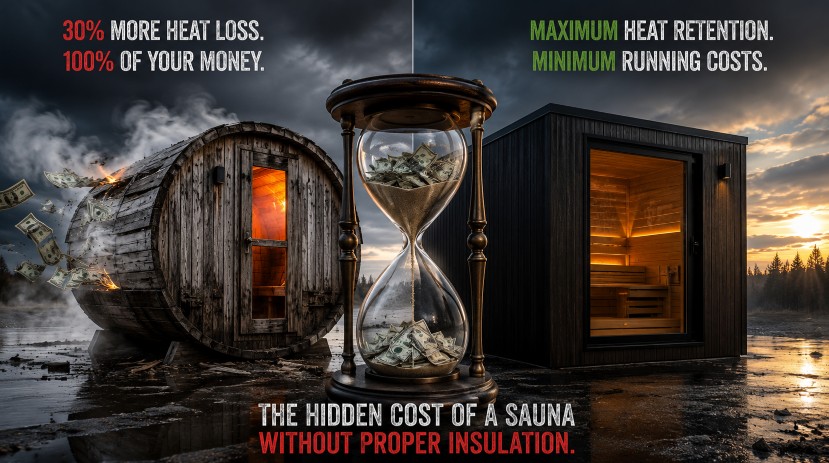
Did you know that poor insulation and missing vapor barriers can waste up to 30% of a sauna’s heating energy? That’s not a rounding error — it’s money leaving through your walls, every single session, for as long as you own the sauna.
Most buyers judge a sauna by its timber, its heater, and its design. Those things matter. But what actually determines how much a sauna costs to run — and how long it lasts — is hidden behind the panels: the insulation layer, the vapor barrier, and how carefully the ventilation and electrical systems are integrated. A sauna is a small building working against a big temperature difference, often minus 10°C outside and plus 80°C inside. Every gap in that barrier is a place where the heater has to work harder, permanently.
Here’s what that looks like in practice. A well-insulated cabin reaches and holds its target temperature efficiently, session after session. Without proper insulation and vapor barriers, the heater has to work up to 30% harder every single time just to compensate for the heat escaping through the walls, the door, and any unsealed gaps. That’s not a one-off loss — it repeats every session, for as long as the sauna is in use. For a private home used a few times a week, that’s a steady, avoidable drain on the electricity bill. For a hospitality venue running the sauna daily, that same 30% compounds across hundreds of sessions a year, turning a small design shortcut into a significant, ongoing operating cost.
And electricity is only half the story. Moisture that isn’t stopped by a proper vapor barrier doesn’t just disappear — it works its way into the wood structure behind the panels, where it causes rot, mold, and warping that no amount of premium timber on the outside can prevent. Repairing that kind of hidden damage almost always costs more than building it correctly the first time, and it’s rarely covered by warranty once poor installation is the cause.
This is exactly why Sauna4Soul treats insulation, vapor barriers, ventilation, and electrical integration as core engineering — not an afterthought behind the visible finish. A sauna is a long-term investment in comfort and wellbeing. The wood and the heater give it character. What’s built into the walls is what gives it a future — lower running costs, a stable structure, and a heat experience that stays consistent for the sauna’s entire lifetime, not just the first season.
The real question isn’t “how much does correct sauna insulation add to the price?” It’s “how much does the lack of it quietly take away, year after year?”