10 Questions to Ask a Sauna Manufacturer Before You Order
An outdoor sauna is not a garden accessory. It is a small, heavily insulated building that will sit outside through winters and summers, work against a temperature difference of ninety degrees or more, and — if it is built properly — outlast most of what else is in your garden.
Almost everything that decides whether that goes well is invisible in a photograph.
So this is not an article about our saunas. It is the list of questions we think you should ask any manufacturer before you pay a deposit — including us. For each one: why it matters, and what a straight answer sounds like. Print it, take it to three suppliers, and compare.
Our own answers are at the end, in one block, so you can skip them if you’d rather just take the list.
1. What is behind the panelling?
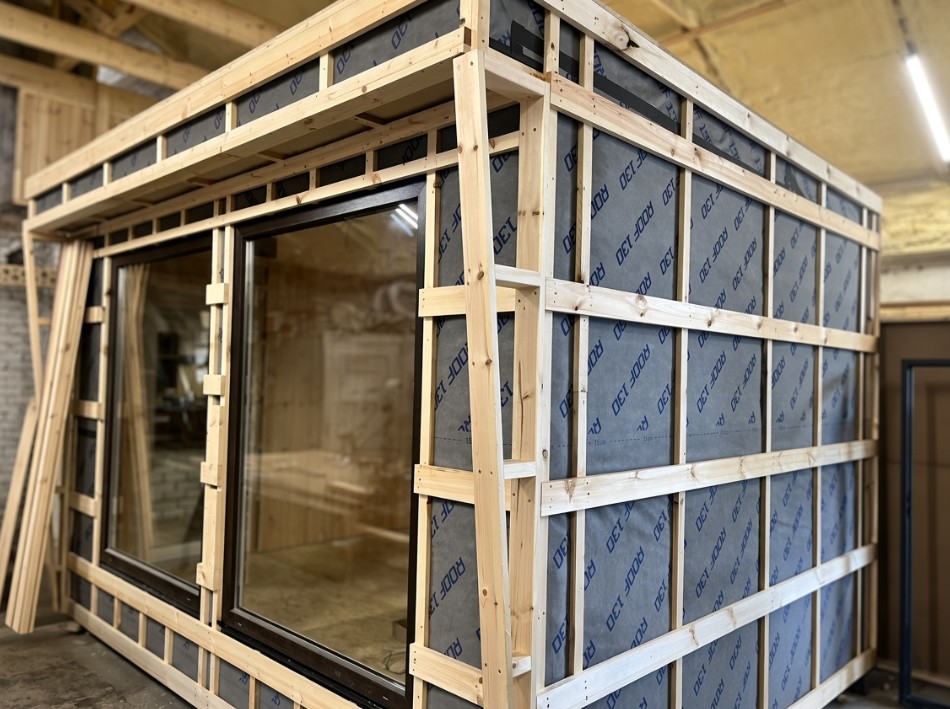
Why ask: The timber you can see is the part that sells the sauna. The part that decides what it costs to run is behind it — the insulation layer and the vapour barrier. Poor insulation and a missing or badly sealed vapour barrier can waste up to 30% of a sauna’s heating energy, every session, for as long as you own it. Moisture that gets past a vapour barrier doesn’t evaporate; it goes into the structure, where it causes rot and warping that no premium cladding on the outside can prevent.
A good answer sounds like: a specific description of the layers — insulation, vapour barrier, how the barrier is sealed at the joints, at the door frame and around the heater or chimney. Vague (“it’s fully insulated”) is not an answer.
2. How does it ventilate?
Why ask: Ventilation is the most commonly skipped part of a small sauna, because it is invisible and cutting it saves money. Without proper air movement the heat sits in layers, the löyly feels heavy and flat, and the cabin dries out slowly after use — which is the beginning of every moisture problem.
A good answer sounds like: where the air comes in, where it goes out, and how the sauna dries after a session. Someone who has thought about ventilation will tell you without being pushed.
3. What wood — inside and outside, separately?
Why ask: These are two different problems. The exterior has to survive weather and UV. The interior has to be safe to touch at 90°C, which rules out anything resinous or high-conductivity. Ask about both, and ask whether the wood is thermally treated — thermal treatment changes how timber behaves in moisture, and it is not the same thing as a surface coating.
A good answer sounds like: named species for both, and a clear statement of what is treated and how.
4. Which heater, from which manufacturer, and who handles the electrical side?
Why ask: The heater is the one component most makers buy rather than build, so it is easy to check independently. A named brand and model can be looked up, compared and serviced years from now. An unnamed heater cannot. Ask how the output was matched to the cabin — an undersized heater never quite gets there, an oversized one bakes the air.
A good answer sounds like: the brand and model, the output, why that output for this cabin, and a clear statement of where their responsibility for the electrical work ends and your local electrician’s begins.
5. What exactly is included in the price?
Why ask: This is where quoted prices stop being comparable. Heater, benches, lighting, glass, ventilation, delivery — any of these can be in or out, and two quotes that look 3,000 euros apart can end up identical once the list is complete.
A good answer sounds like: an itemised list of what is included and, just as important, what is not. Ask specifically about delivery, because it is the largest item people assume is included.
6. Does it arrive assembled, and who puts it together?
Why ask: A sauna delivered whole and a sauna delivered as a flat pack are two completely different purchases. The second one needs a builder, a schedule and a plan for what happens when a panel doesn’t fit. It also changes what happens on your site: a fully assembled cabin needs a truck with a crane that can physically reach the spot where it will stand.
A good answer sounds like: a clear statement of which it is, and — if it comes assembled — what access their delivery vehicle needs.
7. What is the warranty, in writing, and what is excluded?
Why ask: The exclusions tell you more than the length. Almost every warranty in this industry excludes damage caused after delivery, and most exclude problems caused by incorrect installation or by the ground the sauna stands on. That is reasonable. What matters is that it is written down before you pay, not explained afterwards.
A good answer sounds like: a document you can read now, with the exclusions stated plainly rather than found later.
8. What happens if something fails in three years, in my country?
Why ask: This is the question that separates a warranty on paper from a warranty in practice. A two-year guarantee from a manufacturer 2,000 km away is only as good as the arrangement for getting someone to your garden. Many small manufacturers — most, honestly — do not have that arrangement yet. That is not automatically a reason to walk away. It is a reason to know it before you buy rather than after.
A good answer sounds like: the truth. Either they have a service partner in your country and can name them, or they don’t and they say so and explain how they would actually handle it. An evasive answer here is the most useful red flag on this list.
9. Who actually builds it?
Why ask: A significant part of this market is resellers with a brand, buying finished cabins from a factory they will not name. There is nothing dishonest about that in itself — but it changes who you are dealing with when something needs solving, and it usually means nobody can answer questions 1, 2 and 4 in any detail.
A good answer sounds like: where the workshop is, and evidence that the people selling it are the people building it. Photographs from inside their own production are hard to fake and easy to ask for.
10. Can I see one, or talk to someone who owns one?
Why ask: Every sauna looks good in a rendering. A real one, three winters in, is the only honest evidence of how the timber has aged, whether the door still shuts properly, and what the heat actually feels like. A manufacturer confident in their product will find you a way to see one.
A good answer sounds like: an offer — a showroom, a venue where one is installed, or an existing owner willing to talk. Reluctance here is worth noticing.
Our answers
Because it would be poor form to publish this list and not answer it ourselves.
- Behind the panelling: insulation and a vapour barrier on every model, sealed at the joints, treated as structural engineering rather than as a finishing step. We wrote about why at length in The Hidden Cost of a Sauna Without Proper Insulation.
- Ventilation: designed into every cabin, with defined inlet and outlet, so the sauna dries properly after use.
- Wood: thermally treated timber on the exterior of every model, in four finishes. Interior in two tiers — Basic (aspen, thermo pine) and Lux (thermo aspen, thermo radiata, thermo ayous). Basic is not a lesser option; it is a different character.
- Heaters: Harvia and HUUM, electric or wood-burning depending on the model. The output is selected by kW against the cubic volume of the room, so it is never undersized and never oversized. The sauna arrives plug and play — everything inside it is built and wired by us. What we cannot do is bring the electrical supply to where the sauna will stand: that is the owner’s side, and it has to be done to the regulations of your own country or region.
- Included in the price: the sauna complete with heater, benches and LED lighting in a neutral white, and delivery within the EU is included in the price you see. Outside the EU, delivery is quoted separately along with customs.
- Assembly: it arrives fully assembled, on a truck with a crane. Nothing is built on your site. What we need from you is access for that truck.
- Warranty: two years on every model, in writing. Manufacturing defects are covered; damage occurring after delivery is not. And since this article is about honest answers, here is ours in full. We cannot promise you twenty years of anything, and neither can anyone else selling you an outdoor sauna. The heater is made by someone else and its manufacturer does not promise ten or twenty years, so we won’t promise it on their behalf. Thermally treated timber has only been on the market for around a decade — it performs very well over that decade, but nobody yet has twenty-year evidence, and we are not going to invent it. Charred-timber techniques have lasted centuries in Japan; that is their history, not our proof. What we will say, and mean, is this: knowing how these saunas are built — the insulation, the vapour barrier, the structure behind the cladding — we are not afraid to tell you yours will still be standing and in use in twenty years. That is our conviction, stated as conviction. The guarantee is two years.
- Service abroad: we do not yet have a service partner network across every country we deliver to. We are a small manufacturer and building that properly takes time. What we do instead is deal with it directly, case by case, and we would rather tell you that now than discover it together later.
- Who builds it: we do, in our own workshop in Latvia. We publish photographs from inside production regularly, including what happens to a sauna before it ever leaves the workshop.
- Seeing one: honestly, it depends where you are. We build these ourselves and there is no showroom in every country — claiming otherwise would be exactly the kind of answer this article warns you about. Tell us where you are and we’ll tell you straight what is possible.
If a manufacturer answers all ten of these clearly, you can buy from them with confidence, whether or not that manufacturer is us. If they can’t answer them, the price they quoted is not the price you will pay.
Questions about your own project? Write to us at [email protected] — or ask the assistant on this site, which will answer honestly and hand you over to a person the moment it doesn’t know.